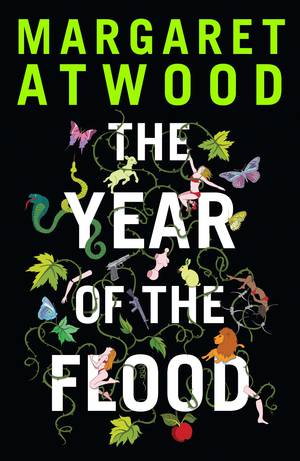
 A tale of a dysfunctional future society and post-apocalyptic survival (or otherwise?) that celebrates and gently mocks the extreme environmentalist religion whose members are among the few with the skills and resources to endure after the "flood" of illness that wipes out most of the population. Closely entwined with her previous novel Oryx and Crake, this features several of the same characters and institutions and is set during roughly the same period of time. I enjoyed it, although it is pretty violent in places and some of her ideas of the future are rather disturbing, particularly in the light of her comment in the acknowledgements section that the novel "is fiction, but the general tendencies and many of the details in it are alarmingly close to fact".
Thursday, 19 July 2012
The Year of the Flood - Margaret Atwood
A tale of a dysfunctional future society and post-apocalyptic survival (or otherwise?) that celebrates and gently mocks the extreme environmentalist religion whose members are among the few with the skills and resources to endure after the "flood" of illness that wipes out most of the population. Closely entwined with her previous novel Oryx and Crake, this features several of the same characters and institutions and is set during roughly the same period of time. I enjoyed it, although it is pretty violent in places and some of her ideas of the future are rather disturbing, particularly in the light of her comment in the acknowledgements section that the novel "is fiction, but the general tendencies and many of the details in it are alarmingly close to fact".

Tuesday, 1 May 2012
The Long Song - Andrea Levy
In a fascinating 'writing of' section, the author explains that her intention in writing this book was to explore slavery as "a massive social system - a society in the true sense - that endured for three hundred years". In emphasising the "guile and humour" needed to survive, she creates realistic - strong yet flawed - characters, and succeeds in her aim of portraying slaves as more than "simply a mass of wretched voiceless victims"". This focus on complexities and contradictions is also applied to the white reformers, particularly the newly-arrived Englishman who is unapologetically delighted with his cleverness when he tells the slave July of his plan to marry the white mistress so that they can be together, and whose ideals give way to anger and cruelty when he fails in his attempts to persuade the freed slaves to work the same long hours as before. Most poignant for me was the way in which slave children were treated as property, with the casual removal of the child July from her mother to be a house servant echoed later in the way July's own child was taken away to England, and particularly the surprise and disbelief with which July's attachment to the master's child was met: "But what, Miss July, did you wan' keep that little pickney for your own?" The description of dances arranged so that coloured women could meet white men in the hope of "raising the colour" of their children was horribly plausible, both in the fine graduations of status from 'mulatto' to 'mustiphino', and in the demeaning entrance examination where lips, nose, hair and skin were assessed for negro characteristics. Finally, in keeping with this novel's refusal to tell a simple story, the desperate harshness of post-emancipation survival is also described. Despite the sometimes dark subject matter, this is an engaging and enjoyable book, with an often playful tone.
Monday, 9 April 2012
36 Arguments for the Existence of God - Rebecca Goldstein
 This was one of those happy library finds that made me want to run out and buy the author's entire back-catalogue (or possibly just hide under the duvet and sulk because I'll never be as clever as she is). The very likeable hero Cass is uncertainly enjoying his new-found fame and success after publishing a best-selling psychology book in which he demolishes the '36 arguments' of the title while asserting that 'theistic propositions' like 'God exists' are confusing and irrelevant metaphors for the attitudes and emotions which form the true basis of religion: "what it feels like to hold a spiritual attitude to the world and live accordingly". A lively debate on this topic forms the climax to an entertaining story in which Cass is pitted against a range of characters ranging from the hyper-rational but heartless Lucinda, who believes that "most of what matters in life is a zero-sum game", to the increasingly delusional Professor Klapper, who considers Cass a Judas because he refused to write a dissertation on the Qabalistic significance of the potato kugel. For most of the novel I felt that the balance between the irrational and rational characters was not quite being held, as Klapper seemed by far the most ridiculous and destructive figure in the book, but the poignant heroism of the young Valdener Rabbi who gives up his potential future as a mathematical prodigy to return to his community is described with such warmth that I changed my mind on this at the novel's conclusion. As an entertaining bonus, 'Cass's' appendix containing the 36 arguments and their refutations is included in full as an appendix to the novel.
Advice for Strays - Justine Kilkerr
 This powerful story initially presents itself as a rather charming fantasy about the return in adulthood of a young girl's unusual imaginary friend - a lion - but soon turns into something rather darker. As it gradually emerges that the child had reasons to need such a protector, the question begins to be raised - at what point does a necessary coping mechanism become unhelpful and destructive? The book manages to maintain psychological realism while dealing with wildly unrealistic content, as the lion's actions become harder to restrain, and is genuinely disturbing in places (how troubled do you have to be for your own imaginary friend to decide you are "asking for it"?), but manages to remain an enjoyable read for the most part. I loved the ending, as the gradual disconnection was described from both points of view, with the lion losing his memory as he fades away, and the girl waiting for him to return while deep down knowing that she needs him not to.
Tuesday, 31 January 2012
The Coward's Tale - Vanessa Gebbie
 The clever narrative structure of this gentle collection of stories about a Welsh community's secrets in the aftermath of a mining disaster pulls the reader along - like the newly-arrived small boy who listens entranced to the old beggar's lyrical tales about the mysterious behaviour of the town's inhabitants, we find ourselves wondering what is truth, what is myth, and perhaps also how much it matters. An intriguing and engaging book with a surprisingly uplifting ending.
Tuesday, 18 October 2011
Homesick - Eshkol Nevo
 This story about a young Israeli couple making an attempt to live together was an unusual reading experience, in that I seriously considered abandoning it half-way through, but persevered and was glad I did. With hindsight I think that reflects well on the skill of the author in managing to convey the loss and alienation felt in different ways by each of the multiple narrators so well that it almost pushed me away, before allowing most of them to experience some form of homecoming at the novel's conclusion. I felt that it was significant that most of the characters are able to achieve this because they were "homesick" for something they themselves had withdrawn from, whereas the only character who was still trapped at the end (literally, in an Israeli prison) was the Arab worker whose family had fled their home years before and were unable to return.
The Immortal Life of Henrietta Lacks - Rebecca Skloot
 This was one of those books that is utterly captivating but rather hard to describe, as it somehow manages to form a coherent whole out of strands of biography, memoir (as the author's research becomes part of the narrative), medical history, and ethical debate. The focal point for all of these aspects is the life and legacy of a young woman called Henrietta Lacks, who died of cancer in 1951, unknowingly leaving behind a sample of cells from the tumour on her cervix, which became 'HeLa' - "the world's first immortal human cells". I finally tracked it down after being given a strong recommendation for it months ago, and was very glad it did because it really got me thinking and kept popping up in conversation with everyone I spoke to for weeks afterwards. I was surprised to discover that informed consent is still not always required for cell research (e.g. in the UK "Consent is not required to use tissue obtained from living patients if the tissue is anonymous to the researcher and the project has research ethics approval"), and was in total sympathy when reading about the difficulties the Lacks family had in accepting what had happened - but intriguingly, when I mentioned the book to a friend currently doing scientific research, she appeared utterly bemused by the idea that anyone might object...
Subscribe to:
Posts (Atom)