Showing posts with label YES. Show all posts
Showing posts with label YES. Show all posts
Wednesday, 2 March 2016
The Good Man Jesus and the Scoundrel Christ - Philip Pullman
In this retelling of the gospel story (which is also a fascinating exploration of how and why such stories come to be written) "Jesus" and "Christ" are two separate characters: twins, who embody different kinds of religious faith and have very different ideas about how to do God's work. I remember being very impressed a few years ago by David Boulton's "Who on Earth Was Jesus?", which emphasises the distinction between the "Jesus of history" and the "Christ of faith", and I liked the way that this idea was humanised and explored in this story, as Jesus simply speaks from his beliefs, while Christ, the chronicler of these events, is persuaded by a mysterious stranger that the Kingdom of God can be brought about by "writing about things as they should have been" and "letting truth into history". This leads to reversals such as Jesus's encounter with Mary and Martha, where he actually tells Mary to "go and help your sister", but Christ feels that this was "another of those sayings of Jesus that would be better as truth than as history". The way that events are embellished into myths is also nicely illustrated by Christ's encounter with Thomas after Jesus's death, where the people present are persuaded of the resurrection without seeing wounds from the crucifixion, but soon the "vivid and unforgettable" story of Thomas touching the wounds becomes widespread. I was also struck by Christ's final thoughts on the allure of storytelling, as he reflects on the morality of the newly formed church and his part in its creation, and concludes that he still wants to be involved in creating a record of Jesus's life so that he can "knot the details together neatly to make patterns and show correspondences, and if they weren't there in life, I want to put them there in the story for no other reason than to make a better story".

Wednesday, 4 November 2015
All My Puny Sorrows - Miriam Toews
This deeply likeable book about a woman struggling to hold on to her suicidal sister is both a strangely enjoyable read and a powerful reflection on the nature of suffering, the inadequacies of psychiatric care, and the case for euthanasia. I was intrigued by the idea discussed in the book (in the context of Mennonite families whose ancestors had fled from persecution in Russia after the revolution) that "suffering... is something that is passed from one generation to the next, like flexibility or grace or dyslexia", but assumed that it was meant metaphorically. Shortly after reading the book, however, I came across this article on inherited trauma, which suggests a disturbingly literal interpretation. I was horrified to discover on reaching the end that the book was based on true events - I suspect it would have been a much more painful read if I had been aware of that at the start.
Friday, 17 April 2015
We Are All Completely Beside Ourselves - Karen Joy Fowler
I absolutely ADORED this book, and was relieved to find that my prior knowledge of it from reading several detailed reviews did not spoil it for me at all. I think that this was because, in addition to being brilliantly written, it took a subject that already fascinated me and explored it from a new perspective, subverting my expectations around issues of perceived capabilities, direction of influence, and family relationships, and considering the long-term implications of an unusual situation through well-realised characters and compellingly ambivalent relationships. One particular memory of how the narrator's sister used to "press her face and body into my back, match me step for step when we walked, as if we were a single person" resonated with me as it is something my own children do a lot at the moment. I can also thank the author for introducing me to the "uncanny valley" effect, which I found highly intriguing.
Tuesday, 14 October 2014
Thinking, Fast and Slow – Daniel Kahneman
This fascinating book is
full of insights into human judgement and decision making, with an emphasis on
the Nobel-winning collaboration between Daniel Kahneman and Amos Tversky, in
which they challenged the idea that human thinking is fundamentally rational,
and showed how “systematic errors” of judgement can be explained, not by
emotional interference, but by “the design of the machinery of cognition”. The book includes two of Kahneman &
Tversky’s key papers, including 1974’s “Judgment under uncertainty: heuristics
and biases”, in which they presented three major heuristics that we use to
answer questions about probabilities or estimated values (representativeness,
availability, and adjustment from an anchor) and demonstrated a range of biases
that each frequently gives rise to. The
“fast and slow” thinking of the title refers to the “two systems” or modes of
thought that much of the book discusses: the automatic, quick, involuntary and
intuitive “System 1”, and the effortful, slow, complex and logical “System 2”.
One thing I particularly
enjoyed about this book was the inclusion of lots of striking case studies and
experimental results, such as:
- An office kitchen honesty box where the level of contributions increased sharply when an image of eyes “primed” the idea of being watched;
- Zajonc’s classic experiment demonstrating our liking for the familiar, where made up words were more likely to be judged to mean something good if the participant had previously seen them;
- Kahneman’s own discomfort as an examiner when he realised how strongly his grades for subsequent questions were influenced by the first essay he’d read from that student (a “halo effect”);
- Experiments where the ratings of competence given based on brief viewings of politician’s faces (generally higher for faces having “a strong chin with a slight confident-appearing smile”) correctly predicted (with around 70% success) the winner in an election;
- “Anchoring effects” where even an obviously random number picked on a wheel of fortune influences estimated answers to numeric questions, and even estate agents are influenced by the asking price when valuing a house, despite claiming not to be;
- An analysis showing the absence of any persistent variation in the results obtained by professional investment advisors, suggesting that successful stock picking is a matter of chance rather than skill – hard to believe because “we are far too willing to reject the belief that much of what we see in life is random”;
- A few shocking illustrations of the “planning fallacy” where forecasts are “unrealistically close to best-case scenarios” because others’ experiences and potential setbacks are not considered – such as Kahneman’s own team of textbook writers (who estimated they had two years’ work left, then learned that similar projects had a 40% failure rate and took around eight years if they did complete, but persevered anyway, finishing eight years later when the book was no longer in demand), and the Scottish Parliament building, originally budgeted at £40 million but finally completed for £431 million;
- An illustration of the costly effects of loss-aversion, where self-imposed goals act as reference points for our decisions, such as the New York cab drivers who go home early on (potentially high-earning) rainy days because they’ve met their daily targets, and work long hours on sunny ones when fares are scarce;
- A graph on reported life satisfaction, showing a peak at the time people got married and a sharp dip afterwards, which becomes less disturbing when read as “a graph of the likelihood that people will think of their recent or forthcoming marriage when asked about their life”.
Although I’m sure I’m
still susceptible to the many biases described in this book, I have noticed my
own thinking to be changed by the ideas described here on several
occasions. I found myself including “the
law of small numbers” (that “small samples yield extreme results more often”)
in a mental list of possible reasons for the difference in litter distribution
in different areas of my road. I once
shouted “regression to the mean” at the TV when a presenter spoke of poor
performance following a win as a “curse”. I resisted the urge to throw in extra items
when selling on eBay, because I’d learned that people evaluate sets by forming
an impression of the average or typical item, and therefore adding lower-value
items can actually devalue the entire set.
More significantly, two sections of this book have led to my strangely
calm and agreeable attitude to a potentially life-changing decision that last
year filled me with dread. Firstly, I
became convinced that much of my resistance to a big change is probably because
our innate loss aversion makes us value what we already have more than what we
might gain (“the disadvantages of a change loom larger than its advantages,
inducing a bias that favours the status quo”).
Secondly, I was reminded that, because even a drastic change like
paralysis only affects people’s mental state when they’re focused on it, and
other things regain focus over time, “nothing in life is as important as you
think it is when you’re thinking about it”.
Some of the questions
raised in this book are extremely hard to answer – such as whether people’s
reluctance to automate life-or-death decisions, based on the “stubborn
psychological reality” that “for most people, the cause of a mistake matters”,
making a death caused by computer error seem more tragic than one caused by a
human, should be overruled if an algorithm is available that makes fewer
mistakes than a human expert. I
particularly struggled with the material in the final section about the
contrast between the evaluations and priorities of the “experiencing self” and
the “remembering self” (which disregards the duration of experiences, basing
evaluations instead on moments of peak intensity and the way situations
end). Despite acknowledging that
“memories are all we get to keep from the experience of living”, Kahneman mostly
presents our tendency to base our decisions on the priorities of the
“remembering self” as a mistake, but I felt (with my own experience of
childbirth in mind) that – since we only experience each situation once but
live with the memory of it for the rest of our lives – the emphasis on memory
seemed reasonable, although choosing to disregard lived experience does of
course raise major concerns. This section seemed to suggest more questions than
it answered, such as the challenging question of whether medical interventions
should be prioritised and designed based on how feared a condition is, how much
suffering people actually experience in their daily lives, or how they evaluate
their situation when reflecting on it.
In his conclusion,
Kahneman notes with regret that in attempting to improve judgements and
decisions, “little can be achieved without a considerable amount of effort”,
and that the main route to avoid biases is to learn enough about them to recognise
situations where errors occur, and then to consciously slow down and engage
System 2. He does also present some helpful
advice and techniques though:
- “Decorrelate error” by making judgements as independent as possible, e.g. when conducting a meeting, ask each participant to summarise their opinions in writing first;
- In single-issue negotiations, avoid anchoring effects by going first if possible, and if you think the other side has made an outrageous offer, “make a scene, storm out or threaten to do so, and make it clear – to yourself as well as to the other side – that you will not continue the negotiation with that number on the table”;
- Before making significant decisions, hold a “pre-mortem” meeting where people imagine a disastrous outcome for the currently favoured plan;
- Start by considering base rates and averages when making estimates and predictions, e.g. always obtain and use statistics from similar projects as a baseline when making predictions, and consider how strong the correlation is between the predictors you’re considering and the result;
- Use simple checklists and formulas (such as the Apgar score) to assist with decision making – e.g. conduct interviews with standardized, factual questions, using “a disciplined collection of objective information and disciplined scoring of separate traits” to rate candidates;
- Use “risk policies” such as “never buy extended warranties” to group gambles together when considering potential losses and gains, and remember that “you win a few, you lose a few”;
- Remember that “intuition cannot be trusted in the absence of stable regularities in the environment”, and that experts are only reliable when they have experienced good feedback from a predictable environment.
Perhaps more
controversially, he also concludes (with Richard Thaler and Cass Sunstein, the
authors of “Nudge”) that the vulnerability of human decision making to biases,
particularly the powerful impact of framing effects, means that people “often
need help to make more accurate judgements and better decisions, and in some cases
policies and institutions can provide that help”. The “libertarian paternalism” advocated here
consists of things like making pension plans opt-out rather than opt-in, and regulating
the way that messages of importance are communicated (such as displaying the
more intuitive “gallons-per-mile” alongside mpg on new cars) in order to
provide a “nudge” towards decisions believed to serve people’s long-term
interests.
Early in the book, Kahneman
describes experiments using problems with intuitively appealing wrong answers that
could be solved correctly with only a little mental effort. He describes people who are more able to
resist the tempting fallacies (presumably by deliberately slowing down to check
their initial answer and search their memories for additional relevant facts)
as “more alert, more mentally active, less willing to be satisfied by
superficially attractive answers, more skeptical about their intuitions”. According to Keith Stanovich, these qualities
are not guaranteed by the possession of high “algorithmic” intelligence, but
rather constitute a separate ability, “rationality” (or being “engaged”, as
Kahneman describes it). It would appear
that this is the aptitude that we need to develop if we wish to avoid some of
the pitfalls described so convincingly in this book.
Sunday, 12 October 2014
The Ocean at the End of the Lane - Neil Gaiman
This classic Gaiman fantasy adventure manages to pack in a lot of thoughtful observations about childhood ("Adults follow paths. Children explore.") and the nature of memory ("Different people remember things differently, and you'll not get any two people to remember anything the same, whether they were there or not.") I loved the opening epigraph, a quote from Maurice Sendak that sets the tone perfectly: "I remember my own childhood vividly... I knew terrible things. But I knew I mustn't let adults know I knew. It would scare them." There were some powerful and insightful scenes, such as the father trying to drown his son in the bath while under the influence of an evil spirit, but failing because of his grim determination not to hit his children as he was hit, and the child's later announcement when presented with the possibility of erasing that portion of time that he wants to remember it "because it happened to me. And I'm still me." The ending, where the narrator's briefly regained memories and understanding fade away once again, is beautiful and bittersweet.
Saturday, 26 July 2014
Life After Life - Kate Atkinson
I adored this slightly insane tale of multiple alternative versions of one woman's life, which made me want to grab a pen and start charting the many decision points and their consequences, an urge I haven't felt since trying to untangle the many connections and chance encounters in the same author's One Good Turn. The sections on life in World War II (from the German as well as British perspectives) were horribly compelling, and I loved the way that many details echoed through Ursula's different lives, and some events seemed to have a force of their own, finding a way to happen despite choices that 'should' have stopped them, like water flowing downstream around an obstacle, requiring more and more dramatic actions to be taken to prevent them...
Sunday, 9 February 2014
The Rabbit Back Literature Society - Pasi Ilmari Jääskeläinen
This Finnish novel about a mysterious group of authors and the society that shaped them was a "wild-card" present and I'm extremely glad to have received it - it is both brilliantly insane, and insanely brilliant. As the story develops, we are presented with an increasingly disturbing set of answers to the perennial question of where writers get their ideas from, as well as being reminded that nothing is ever as it seems. Although this book contains several elements that I would usually find irritating - a blurred line between fantasy and reality, and overt reminders that we are reading a work of fiction - I was drawn in by the viewpoint of the central character, who is both likeable and strongly grounded in reality, and totally won over by the originality of the ideas explored.
Saturday, 11 August 2012
Girl Reading - Katie Ward
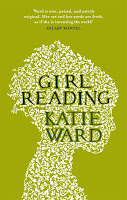 A collection of vivid short stories on the theme of images of women reading. One of the cover review quotes compared this to David Mitchell's Cloud Atlas, and it is indeed another impressionistic journey through time, made up of diverse stories told from very diverse viewpoints. In both books, each story is individually powerful, but they are enhanced by the many subtle echoes creating resonances between the tales.
The two stories that had the greatest impact for me were both about relationships between women: one about an 18th century lady mourning her lover and the completion of her posthumous portrait, and the other in which a pair of 19th century twins meet after a long period apart following the breakup of their partnership as celebrity mediums.
The only one that lost me slightly at the time, although strangely it seems to have grown on me in memory, was one set in a dystopian future characterised by almost total virtualisation and disengagement from direct experience. In a flirtation with meta narrative that seemed a little out of keeping with the naturalistic tone of the rest of the book, this story features a 'Sibil' that allows people to engage with a series of artworks via an immersive experience that conveys the (or at least, 'a') story behind the image. I thoroughly enjoyed this book but this last story did make me uncomfortably aware that I had not seen any of the images that inspired it...
Monday, 9 April 2012
36 Arguments for the Existence of God - Rebecca Goldstein
 This was one of those happy library finds that made me want to run out and buy the author's entire back-catalogue (or possibly just hide under the duvet and sulk because I'll never be as clever as she is). The very likeable hero Cass is uncertainly enjoying his new-found fame and success after publishing a best-selling psychology book in which he demolishes the '36 arguments' of the title while asserting that 'theistic propositions' like 'God exists' are confusing and irrelevant metaphors for the attitudes and emotions which form the true basis of religion: "what it feels like to hold a spiritual attitude to the world and live accordingly". A lively debate on this topic forms the climax to an entertaining story in which Cass is pitted against a range of characters ranging from the hyper-rational but heartless Lucinda, who believes that "most of what matters in life is a zero-sum game", to the increasingly delusional Professor Klapper, who considers Cass a Judas because he refused to write a dissertation on the Qabalistic significance of the potato kugel. For most of the novel I felt that the balance between the irrational and rational characters was not quite being held, as Klapper seemed by far the most ridiculous and destructive figure in the book, but the poignant heroism of the young Valdener Rabbi who gives up his potential future as a mathematical prodigy to return to his community is described with such warmth that I changed my mind on this at the novel's conclusion. As an entertaining bonus, 'Cass's' appendix containing the 36 arguments and their refutations is included in full as an appendix to the novel.
Tuesday, 18 October 2011
The Immortal Life of Henrietta Lacks - Rebecca Skloot
 This was one of those books that is utterly captivating but rather hard to describe, as it somehow manages to form a coherent whole out of strands of biography, memoir (as the author's research becomes part of the narrative), medical history, and ethical debate. The focal point for all of these aspects is the life and legacy of a young woman called Henrietta Lacks, who died of cancer in 1951, unknowingly leaving behind a sample of cells from the tumour on her cervix, which became 'HeLa' - "the world's first immortal human cells". I finally tracked it down after being given a strong recommendation for it months ago, and was very glad it did because it really got me thinking and kept popping up in conversation with everyone I spoke to for weeks afterwards. I was surprised to discover that informed consent is still not always required for cell research (e.g. in the UK "Consent is not required to use tissue obtained from living patients if the tissue is anonymous to the researcher and the project has research ethics approval"), and was in total sympathy when reading about the difficulties the Lacks family had in accepting what had happened - but intriguingly, when I mentioned the book to a friend currently doing scientific research, she appeared utterly bemused by the idea that anyone might object...
Tuesday, 4 October 2011
The Right Hand of the Sun - Anita Mason
 Having fond memories of studying the Spanish conquest of the Aztec empire at university, I was very interested to find this book and I was not at all disappointed. This is a brilliantly researched account which tells the story from multiple perspectives, emphasising the voices of Cortés's two translators, a Spanish man and an Aztec woman, who had both spent years as Mayan slaves and so both sat uncomfortably between the clashing cultures. This is made particularly clear through the use of names in the book, particularly that of the Aztec emperor - Cortés arrogantly refers to him as "Muckety", the Spanish translator Gerónimo is careful to learn his correct name of Muctezuma, and the Mayan woman Marina (whose name has in turn been "given" to her by Cortés) has grown up hearing tales of his power, and calls him by his title of "Lord-Who-Is-Severe".
Although I am not usually a fan of macho war stories, the battle scenes in this book were so well written that I found them totally gripping, really imagining what it would have been like to be there. Similarly, the engineering feat of constructing several ships in pieces to be carried for miles and assembled in place is described with human passion through the eyes of their designer, bringing the achievement to life. Cortés's coexisting motives of greed, ambition, and sincere religious fervour are also very well portrayed.
My only criticism of this book probably just reveals me as a lazy reader - in the middle section where the narration is given in turn to several of the Spanish gentlemen in Cortés's company, it was hard for me to keep their details and allegiances clear in my head. Other than that, I found the book compelling, rewarding, and convincing. I particularly enjoyed the tantalising glimpses at the end into the possible motivations of the strangely passive Muctezuma: Marina felt that he "knew everything that would happen" in the moment when "a low-class woman from the coast, a slave, raised her eyes and looked him in the face", and Gerónimo remembers a conversation where the emperor mused that "the Lord of the Near lacks a sacrifice" since the youth who had lived for a year as his incarnation on Earth had been killed by a Spaniard before his ritual sacrifice could take place - and as Gerónimo later realises, the other incarnation of the "Lord of the Near" was Muctezuma himself.
Wednesday, 3 August 2011
Mobius Dick - Andrew Crumey
This was a satisfying continuation of my 'books to make your head explode' reading series started by Scarlett Thomas's The End of Mr. Y. I liked the fact that the utterly bizarre cover image, with its pairs of mirrored characters, is in fact a fairly accurate representation of the plotline of much of the book. The whole thing is dense with cross-references, and yet starts with a character poking fun at the people who treat simple verbal coincidences as profound insights. The 'main' narrative concerns a physicist attempting to prevent a possible breakdown of reality caused by a secret plot to build a network of quantum computers, while another narrative strand (which is possibly a piece of writing by the main protagonist about things he doesn't know yet...) describes the experiences of his double.
Like Music, in a Foreign Language, the novel (or at least part of it!) is set in a parallel universe where Communists came to power in the UK following a German occupation during WWII, and in this book this scenario is extended into the past, with one of the narrative strands being, somewhat confusingly, an account of Schrödinger's discovery of his 'wave mechanics' theory of quantum physics, but one written as a counter-factual fiction in a universe where that did not occur. This allows for the cute observation by the author of the Schrödinger novel that it is set in a world that is "quite deliberately one that could not possibly exist. Who could believe such a thing as a female Prime Minister of Britain, or a movie actor elected President of the United States? It would be hard to be more evidently ironic without lapsing into farce." More seriously, the book ends with the same 'author' criticising 'our' world for being indifferent to truth, with our 'ridiculous and decadent' acceptance of the idea of a multiverse of realities leading to relativist chaos.
Like Music, in a Foreign Language, the novel (or at least part of it!) is set in a parallel universe where Communists came to power in the UK following a German occupation during WWII, and in this book this scenario is extended into the past, with one of the narrative strands being, somewhat confusingly, an account of Schrödinger's discovery of his 'wave mechanics' theory of quantum physics, but one written as a counter-factual fiction in a universe where that did not occur. This allows for the cute observation by the author of the Schrödinger novel that it is set in a world that is "quite deliberately one that could not possibly exist. Who could believe such a thing as a female Prime Minister of Britain, or a movie actor elected President of the United States? It would be hard to be more evidently ironic without lapsing into farce." More seriously, the book ends with the same 'author' criticising 'our' world for being indifferent to truth, with our 'ridiculous and decadent' acceptance of the idea of a multiverse of realities leading to relativist chaos.
Thursday, 14 July 2011
The End of Mr. Y - Scarlett Thomas
After Our Tragic Universe made such an impression on me, I had to go back for more. In some ways this is very similar (an ideas-driven book with lots of intelligent dialogue and an interest in the relationship between narrative and reality) but the plot structure is very different: although the topic is loosely "thought experiments", this is a fast-paced thriller which is very far from 'storyless'. I wasn't entirely comfortable with the fact that I found this filed under science fiction in my local library, although on reflection I have to agree that some of its contents (time travel, mindreading, alternative universes) were very much at home there, even if the time travel was into the past and achieved via antiquarian bookshops and homeopathy rather than shiny futuristic machines. Once again, I found this very enjoyable and also challenging (it made me want to read up on some of the references - Heidegger, Derrida, Baudrillard, "Erewhon", "Zoonomia" etc - to get a bit more context for the ideas presented). I particularly liked the idea that if thought and matter are fundamentally the same ("because it is happening in a closed system, in which everything is made from matter"), then special types of thoughts - such as Einstein's relativity theories - could rewrite the structure of the universe. (The application of this idea to quantum physics - "No one had ever said what this tiny stuff should be doing ... So when they looked at it, they found it was doing whatever the fuck it liked" - made me laugh out loud.) Some of the passages where the heroine travels through time and space via others' minds provided opportunities for some powerful empathic writing, for example a section on the experiences of laboratory mice, and another on the private anxieties of teenage girls.
Saturday, 11 June 2011
Our Tragic Universe - Scarlett Thomas
From the gimmicky but desirable black-edged pages & gilt-patterned cover onwards, this book had a strangely powerful effect on me. On finishing it I found myself holding it longingly, wanting to extract more meaning from it and thereby connect with an imagined alternative self who could have written something like it - probably a simple reaction to the number of characters in the book who are writing books or reflecting on the nature of narrative, but one that was later revived when I noticed some points of connection between my own life and the author's.
Much of the book is explicitly about narrative structure. The heroine, Meg, has stalled on her 'literary' novel while successfully churning out genre fiction, but wants to get away from the formulaic and go back to exploring the unfathomable: "I want a tragic universe, not a nice rounded-off universe with a moral at the end." I couldn't quite decide how well I felt the balance was maintained between the 'traditional' and 'storyless' ("closer to a snake letting go of itself") elements of the narrative - there was a strongly plotted containing story with some predictable dramatic developments but there were also deliberately unresolved loose ends, some striking non-sequiturs & red herrings (like the teasing remark that "all stories with animals in them put the animals in peril"), and perhaps most refreshingly, space for reflective dialogue. I liked the idea of 'cultural premonitions' (where, for example, the only narrative direction for an 'unsinkable' ship is downwards...) and the description of modern Westerners aspiring to become fictional characters, and (like a woman playing hard to get so that her 'knight' has a dragon to slay) choosing to act like a character whose story ends in the way they want. In contrast to this, Meg appears to do a reasonable job of taking her own advice - by the end of the book she is (in what is ironically a positive heroic plot development which seems likely to lead to both career success and love!) on the path to becoming an anti-hero - a fool or hermit - spending time immersing herself in hobbies such as jam-making and sock-knitting purely for the experience of doing so.
I'm sure I didn't get everything out of this book that a more sophisticated reader might have done, but I loved it and I'd like to read more of her work.
Much of the book is explicitly about narrative structure. The heroine, Meg, has stalled on her 'literary' novel while successfully churning out genre fiction, but wants to get away from the formulaic and go back to exploring the unfathomable: "I want a tragic universe, not a nice rounded-off universe with a moral at the end." I couldn't quite decide how well I felt the balance was maintained between the 'traditional' and 'storyless' ("closer to a snake letting go of itself") elements of the narrative - there was a strongly plotted containing story with some predictable dramatic developments but there were also deliberately unresolved loose ends, some striking non-sequiturs & red herrings (like the teasing remark that "all stories with animals in them put the animals in peril"), and perhaps most refreshingly, space for reflective dialogue. I liked the idea of 'cultural premonitions' (where, for example, the only narrative direction for an 'unsinkable' ship is downwards...) and the description of modern Westerners aspiring to become fictional characters, and (like a woman playing hard to get so that her 'knight' has a dragon to slay) choosing to act like a character whose story ends in the way they want. In contrast to this, Meg appears to do a reasonable job of taking her own advice - by the end of the book she is (in what is ironically a positive heroic plot development which seems likely to lead to both career success and love!) on the path to becoming an anti-hero - a fool or hermit - spending time immersing herself in hobbies such as jam-making and sock-knitting purely for the experience of doing so.
I'm sure I didn't get everything out of this book that a more sophisticated reader might have done, but I loved it and I'd like to read more of her work.
Friday, 22 April 2011
Border Songs - Jim Lynch
A beautiful, kind and quirky celebration of difference and human connections that acknowledges Andy Goldsworthy's art and Temple Grandin's books as inspirations. The book is set on the US / Canadian border, with the central character (Brandon, a 6'8" dyslexic with a talent for ephemeral art and communicating with animals) joining the border patrol with unexpected effects for the local dairy farming community and the Canadian cannabis smugglers he is pitted against. "Hobbies", when pursued passionately, seem to have redemptive power for many of the characters in this book - Brandon creates art, his father builds a boat, and another man works on "re-inventions", reproducing the failed experiments that led to Edison's creation of the light bulb in order to share the excitement of seeing the first one working. Characters who struggle with impairments also seem to be granted unusual insights as they perceive situations more clearly - as well as the obvious theme of Brandon's talent for noticing the unusual, his mother (struggling with the onset of dementia) is the only one who takes time to really listen to the enigmatic oral historian Sophie, who most people only see through the filter of their own fantasies.
Sunday, 20 February 2011
Arlington Park - Rachel Cusk
A beautifully-written account of a day in an English suburb, with echoes of "Mrs. Dalloway", told through the eyes of a group of women who are all struggling with petty resentments, disappointments and obsessions. I love the clarity of Cusk's writing - the initial section describing the rain sweeping over the city and into the suburb brought vivid images to my mind, which is very unusual for me. Like the other books of hers that I've read ("A Life's Work" & "The Lucky Ones"), this emphasises the frustrations of family life rather than the joys, but it portrays them believably, with some startling observations along the way, and room left for hope at the end.
Friday, 4 February 2011
How to Paint a Dead Man - Sarah Hall
I found this totally captivating - four strands of loosely-linked stories to do with art and loss, all slightly disturbing but utterly fascinating, told in brief sections with very different voices - even one (about a bereaved twin without a clear sense of her own identity) addressed to "you". I am in awe of the precision and power of her writing, and some of the scenes (such as the blind girl trying to understand the mesmerising power of her family's newly acquired television) are lingering in my imagination still - in fact, this was the kind of novel where the characters stayed with me, leaving me trying to unravel mysteries in the plot and envisage "what happened next".
Friday, 14 January 2011
The Sorrows of an American - Siri Hustvedt
I thought this was brilliant - beautiful, intelligent, and compulsively readable all at once. The characters were complex, ambiguous and likeable, the plot was filled with mysteries in the current lives of the central characters as well as their family histories, and it included a convincing and positive portrayal of the work of a psychotherapist illustrating the power of honesty and awareness when directed towards oneself and others. I particularly liked the way it managed to avoid an overly neat resolution without being unsatisfying.
Saturday, 2 October 2010
The Language of Others - Clare Morrall
Beautifully engaging tale about the life of a woman learning to connect with other people, with twin narratives about her past as an awkward girl whose only emotional release was her passion for music, and her present as a mother slowly coming to understand her relationships with those around her. I found this very positive and enjoyable.
Saturday, 18 September 2010
The Hours - Michael Cunningham
Having found Mrs. Dalloway itself a little inaccessible, I was delighted to find that this re-imagining did a great job of capturing its essence and interpreting it for a modern (lazy?) reader. It is a powerful novel in its own right, beautiful and full of vivid characters, but also full of echoes of Mrs. Dalloway, and a mark of its success for me was that it made me feel that I could go back to the original novel and get more out of it after reading this. Most memorable - and unsettling - for me were the sections about the 40s housewife Mrs. Brown, describing the sense of unreality that can come with being alone at home with a small child: "Alone with the child, though, she loses direction. She can't always remember how a mother would act.".
Subscribe to:
Posts (Atom)