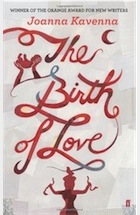
 An absorbing and thought-provoking book dealing with the subject of birth and nonconformity from several different angles: a nineteenth-century physician whose campaign against puerperal fever set him so at odds with the medical mainstream that he ended up in a lunatic asylum; a novelist struggling with the social demands of promoting his book; a mother going through the terrifying beauty of the birth - the gory sundering"; and a prisoner being punished for her belief in family relationships and motherhood in a dystopian future where "it is necessary for the survival of the species that we regulate procreation". My timing was a little off on this one - while pregnant for the second time it was unnerving to read about women dying due to doctors failing to wash their hands after autopsies, and then a detailed account of a second birth that is worse than the first... Despite this, there are moments of warmth and positivity in the book, and the concluding paragraphs, describing the initial reactions of the new parents on meeting their baby daughter, are powerfully uplifting.
Monday, 1 October 2012
The Birth of Love - Joanna Kavenna
An absorbing and thought-provoking book dealing with the subject of birth and nonconformity from several different angles: a nineteenth-century physician whose campaign against puerperal fever set him so at odds with the medical mainstream that he ended up in a lunatic asylum; a novelist struggling with the social demands of promoting his book; a mother going through the terrifying beauty of the birth - the gory sundering"; and a prisoner being punished for her belief in family relationships and motherhood in a dystopian future where "it is necessary for the survival of the species that we regulate procreation". My timing was a little off on this one - while pregnant for the second time it was unnerving to read about women dying due to doctors failing to wash their hands after autopsies, and then a detailed account of a second birth that is worse than the first... Despite this, there are moments of warmth and positivity in the book, and the concluding paragraphs, describing the initial reactions of the new parents on meeting their baby daughter, are powerfully uplifting.

Wednesday, 5 September 2012
The Slap - Christos Tsiolkas
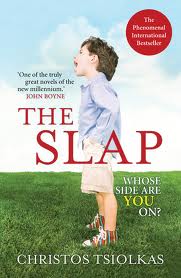 Although complex and engrossing, this initially struck me as a disappointing missed opportunity of a book. The main premise is timely and interesting, but the characters through which it is explored came across as unsympathetic stereotypical extremes, almost caricatures. I also found the writing style alienating - the male characters all seemed to see the world through a filter of sexual desire and barely-controlled violence, and casual racism & infidelity seemed to be the norm. I almost abandoned it part-way through, but it did improve after the first few chapters. Gradually-revealed back-stories added depth and complexity to some of the characters when it was their turn to speak (e.g. the smothering mother who blanked out all negative thoughts in her attempt to cancel out her own past and her initial inability to bond with the baby), and the later sections told from the point of view of the two teenagers were a little more appealing and hopeful. The author also displayed real skill and insight in the portrayal of the ambivalence of close relationships through the moment-by-moment reversals and fleeting contradictory beliefs in the interior monologues.
Saturday, 11 August 2012
Girl Reading - Katie Ward
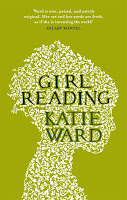 A collection of vivid short stories on the theme of images of women reading. One of the cover review quotes compared this to David Mitchell's Cloud Atlas, and it is indeed another impressionistic journey through time, made up of diverse stories told from very diverse viewpoints. In both books, each story is individually powerful, but they are enhanced by the many subtle echoes creating resonances between the tales.
The two stories that had the greatest impact for me were both about relationships between women: one about an 18th century lady mourning her lover and the completion of her posthumous portrait, and the other in which a pair of 19th century twins meet after a long period apart following the breakup of their partnership as celebrity mediums.
The only one that lost me slightly at the time, although strangely it seems to have grown on me in memory, was one set in a dystopian future characterised by almost total virtualisation and disengagement from direct experience. In a flirtation with meta narrative that seemed a little out of keeping with the naturalistic tone of the rest of the book, this story features a 'Sibil' that allows people to engage with a series of artworks via an immersive experience that conveys the (or at least, 'a') story behind the image. I thoroughly enjoyed this book but this last story did make me uncomfortably aware that I had not seen any of the images that inspired it...
Thursday, 19 July 2012
The Year of the Flood - Margaret Atwood
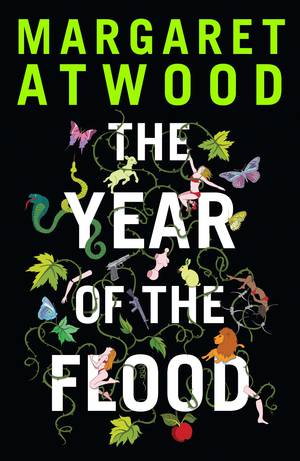 A tale of a dysfunctional future society and post-apocalyptic survival (or otherwise?) that celebrates and gently mocks the extreme environmentalist religion whose members are among the few with the skills and resources to endure after the "flood" of illness that wipes out most of the population. Closely entwined with her previous novel Oryx and Crake, this features several of the same characters and institutions and is set during roughly the same period of time. I enjoyed it, although it is pretty violent in places and some of her ideas of the future are rather disturbing, particularly in the light of her comment in the acknowledgements section that the novel "is fiction, but the general tendencies and many of the details in it are alarmingly close to fact".
Tuesday, 1 May 2012
The Long Song - Andrea Levy
In a fascinating 'writing of' section, the author explains that her intention in writing this book was to explore slavery as "a massive social system - a society in the true sense - that endured for three hundred years". In emphasising the "guile and humour" needed to survive, she creates realistic - strong yet flawed - characters, and succeeds in her aim of portraying slaves as more than "simply a mass of wretched voiceless victims"". This focus on complexities and contradictions is also applied to the white reformers, particularly the newly-arrived Englishman who is unapologetically delighted with his cleverness when he tells the slave July of his plan to marry the white mistress so that they can be together, and whose ideals give way to anger and cruelty when he fails in his attempts to persuade the freed slaves to work the same long hours as before. Most poignant for me was the way in which slave children were treated as property, with the casual removal of the child July from her mother to be a house servant echoed later in the way July's own child was taken away to England, and particularly the surprise and disbelief with which July's attachment to the master's child was met: "But what, Miss July, did you wan' keep that little pickney for your own?" The description of dances arranged so that coloured women could meet white men in the hope of "raising the colour" of their children was horribly plausible, both in the fine graduations of status from 'mulatto' to 'mustiphino', and in the demeaning entrance examination where lips, nose, hair and skin were assessed for negro characteristics. Finally, in keeping with this novel's refusal to tell a simple story, the desperate harshness of post-emancipation survival is also described. Despite the sometimes dark subject matter, this is an engaging and enjoyable book, with an often playful tone.
Monday, 9 April 2012
36 Arguments for the Existence of God - Rebecca Goldstein
 This was one of those happy library finds that made me want to run out and buy the author's entire back-catalogue (or possibly just hide under the duvet and sulk because I'll never be as clever as she is). The very likeable hero Cass is uncertainly enjoying his new-found fame and success after publishing a best-selling psychology book in which he demolishes the '36 arguments' of the title while asserting that 'theistic propositions' like 'God exists' are confusing and irrelevant metaphors for the attitudes and emotions which form the true basis of religion: "what it feels like to hold a spiritual attitude to the world and live accordingly". A lively debate on this topic forms the climax to an entertaining story in which Cass is pitted against a range of characters ranging from the hyper-rational but heartless Lucinda, who believes that "most of what matters in life is a zero-sum game", to the increasingly delusional Professor Klapper, who considers Cass a Judas because he refused to write a dissertation on the Qabalistic significance of the potato kugel. For most of the novel I felt that the balance between the irrational and rational characters was not quite being held, as Klapper seemed by far the most ridiculous and destructive figure in the book, but the poignant heroism of the young Valdener Rabbi who gives up his potential future as a mathematical prodigy to return to his community is described with such warmth that I changed my mind on this at the novel's conclusion. As an entertaining bonus, 'Cass's' appendix containing the 36 arguments and their refutations is included in full as an appendix to the novel.
Advice for Strays - Justine Kilkerr
 This powerful story initially presents itself as a rather charming fantasy about the return in adulthood of a young girl's unusual imaginary friend - a lion - but soon turns into something rather darker. As it gradually emerges that the child had reasons to need such a protector, the question begins to be raised - at what point does a necessary coping mechanism become unhelpful and destructive? The book manages to maintain psychological realism while dealing with wildly unrealistic content, as the lion's actions become harder to restrain, and is genuinely disturbing in places (how troubled do you have to be for your own imaginary friend to decide you are "asking for it"?), but manages to remain an enjoyable read for the most part. I loved the ending, as the gradual disconnection was described from both points of view, with the lion losing his memory as he fades away, and the girl waiting for him to return while deep down knowing that she needs him not to.
Subscribe to:
Posts (Atom)